IWC Schaffhausen Unveils the Pilot’s Venturer Vertical Drive: The First Watch Designed for Spaceflight
Schaffhausen/Geneva, Switzerland, April 14th, 2026
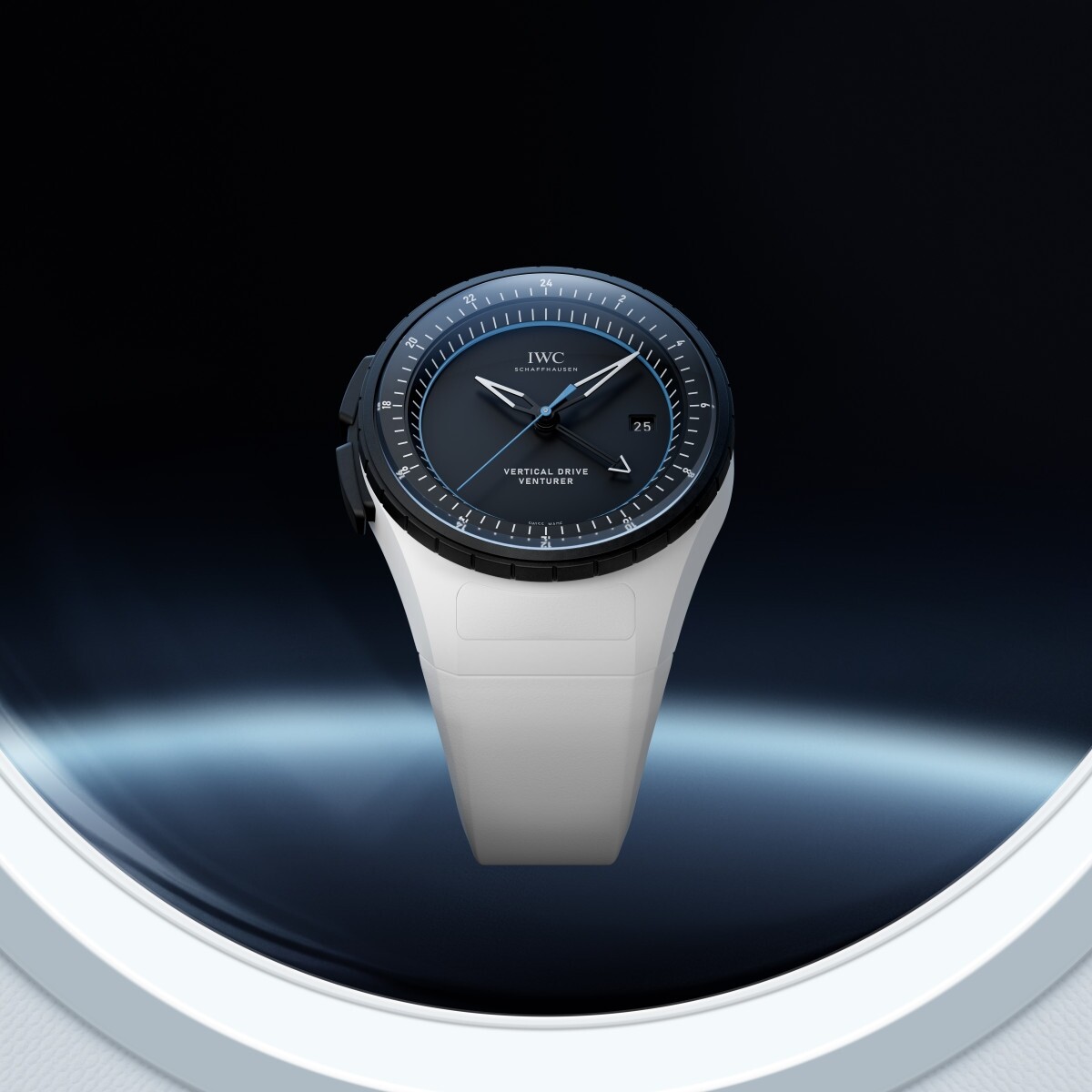
IWC Schaffhausen unveils the Pilot’s Venturer Vertical Drive at Watches and Wonders in Geneva. This next-generation tool watch has been specifically designed and engineered from the ground up for the unique demands of human spaceflight and timekeeping in space.
Inspired by astronauts wearing space suits with gloves, all functions of the watch can be controlled through an innovative, patent-pending rotating bezel system, eliminating the need for a crown. A rocker switch located on the side of the case enables the wearer to change between various functions, including winding the movement and setting the home or mission times.
The Pilot’s Venturer Vertical Drive is crafted using lightweight white zirconium oxide ceramic and Ceratanium®, ensuring high durability and resistance to temperature fluctuations. This tool watch underwent rigorous testing by IWC’s brand partner, Vast, the company developing next-generation space stations. It received spaceflight qualification from Vast for flight on Haven-1, scheduled to be the world’s first commercial space station.
Pushing the Limits of Watchmaking
IWC Schaffhausen boasts 90 years of experience in crafting tool watches for aviation. In recent years, the Swiss luxury watch manufacturer has gained first experiences in space through participating in the Inspiration4 and Polaris Dawn human spaceflight missions. However, every watch that has traveled to space to date has essentially been a modified terrestrial aviation watch.
As commercial space exploration enters a new era, IWC Schaffhausen is now pushing the limits with the Pilot’s Venturer Vertical Drive (Ref. IW328601). This milestone marks the first IWC watch designed and engineered from the ground up for the unique and challenging demands of human spaceflight.
Chris Grainger-Herr, CEO of IWC Schaffhausen:
"When our engineering division XPL developed the Pilot’s Venturer Vertical Drive, they did not simply adapt an existing watch design for use in space. They took a blank sheet of paper and worked to define from scratch what a tool watch for astronauts would have to offer in terms of functionality, ease of operation, time display, and material execution. Every single detail of this watch has been single-mindedly optimized for the unique requirements of human spaceflight and timekeeping in space."
Design and Innovation
Christian Knoop, Creative Director at IWC Schaffhausen:
"The new space age is shaped by innovative and ambitious companies that push the boundaries of science and technology. These emerging players operate much like brands, deliberately harnessing the power of design to inspire people and spark enthusiasm for their bold visions. To reflect this, we have chosen a forward-looking, dynamic, and beautifully minimalist design expression for the Pilot’s Venturer Vertical Drive. With its rounded edges and black and white color scheme, it embodies our vision of a modern space watch and carries IWC’s tool watch legacy into the 21st century."


Designed for Operation Without a Crown
The Pilot’s Venturer Vertical Drive features an innovative, patent-pending rotating bezel system that allows all watch functions to be controlled without the use of a crown. Inspired by astronauts wearing space suits during spacewalks (EVA, or Extravehicular Activity), the watch is designed to be operated while wearing gloves.
The movements of the bezel are transmitted to the winding stem through an efficient clutch system known as “Vertical Drive”. A rocker switch on the side of the case enables the wearer to change between various functions, including winding the movement or setting the two different time zones. The watch can be wound using the integrated oscillating mass or by rotating the bezel anti-clockwise. This hybrid winding system ensures efficient operation both on Earth and in microgravity or zero-gravity environments.
Displaying the Mission’s Reference Time in 24-Hour Format
The Pilot’s Venturer Vertical Drive boasts a matte black dial that is reduced to the absolute essentials and avoids light reflections. With highly legible markings, it displays two different times. The mission’s reference time is indicated by the central hour and minute hand, and also in 24-hour format by a dedicated hand on the outer dial scale, which runs from 00:00 to 24:00.
The necessity for a 24-hour display comes from the fact that a spacecraft or a space station completes an orbital cycle around the Earth roughly every 90 minutes. This means astronauts experience as many as 16 sunrises and sunsets within a 24-hour period. To manage this rapid sequence of day and night, they adhere to GMT (Greenwich Mean Time) or UTC (Coordinated Universal Time).
The central hour and minute hands are normally synchronized with this reference time. If required, however, the hour hand can be moved in one-hour increments to display a second time zone. The edges of the black triangular hour and minute hands are coated with green Super-LumiNova®, while the arrow-shaped tip of the 24-hour hand glows blue in the dark. The blue second hand points to the inner scale, which features a thin ring in the same shade of blue. The color is a nod to the horizon of the Earth as seen by astronauts from space.
This dual-time display is made possible by the newly engineered IWC-manufactured 32722 caliber, an efficient automatic movement with a 120-hour power reserve that includes an integrated GMT module. There is also a date indication at 3 o’clock.
Extreme Robustness and Performance
When ascending to space on a rocket, the engines generate powerful vibrations, and astronauts experience acceleration forces of up to 4g. In space, hardware is exposed to vacuum, radiation, and extreme fluctuations in temperature. Temperatures can exceed 100 °C in direct sunlight and plummet to -150 °C in the shade.
To ensure high robustness and reliable operation during all phases of a mission, the Pilot’s Venturer Vertical Drive is crafted entirely from advanced performance materials. Its case is made of white zirconium oxide ceramic, with a Vickers hardness rating second only to diamond. The rotating bezel and case back are crafted from Ceratanium®, developed by IWC, which combines the lightness and structural integrity of titanium with a hardness and scratch resistance similar to that of ceramic.
The watch is fitted with a white integrated FKM rubber strap, offering excellent thermal insulation and resistance to UV radiation, ensuring extreme durability. The case back features an engraving that symbolically evokes a space vehicle, reflecting humanity’s curiosity and spirit of exploration.
Tested and Certified for Spaceflight by Vast
The Pilot’s Venturer Vertical Drive has undergone extensive type testing by IWC’s brand partner, Vast. Vast is building Haven-1, scheduled to be the world’s first commercial space station. Haven-1 will inform Haven-2, a multi-module, continuously crewed station that is the proposed successor to the International Space Station (ISS).
Max Haot, Vast CEO:
"IWC’s dedication to engineering excellence, delivering uncompromising accuracy, reliability, and astronaut-focused design, aligns perfectly with Vast’s human-centric approach to developing Haven-1. We’re thrilled to see this tool watch go from design and testing to launch."
At their headquarters in Long Beach, California, engineers at Vast conducted thorough evaluations of the watch, assessing its resistance to vibrations and pressure changes, as well as the compatibility of its materials with the Haven-1 environment. The vibration tests, for example, exceeded the typical forces that astronauts experience during ascent. The watch was secured to a platform that generated rapid directional changes, exposing it to forces of up to 10g. After each test, the engineers verified that the watch remained intact and fully functional.
The Pilot’s Venturer Vertical Drive has successfully met all the testing criteria required for Haven-1 spaceflight environments and crew usage, earning an official certification for spaceflight from Vast.
About Vast
Vast is developing next-generation space stations to ensure continuous human presence in space, enabling advanced microgravity research and manufacturing, and unlocking a new space economy for government, corporate, and private customers. Using an incremental, hardware-rich, and low-cost approach, Vast is rapidly developing its multi-module Haven Station.
Haven Demo’s 2025 success made Vast the only operational commercial space station company to fly and operate its own spacecraft. Next, Haven-1 is expected to become the world’s first commercial space station when it launches in 2027, followed by additional Haven modules to enable permanent human presence by 2030.
 Back
Back